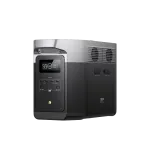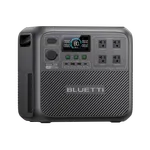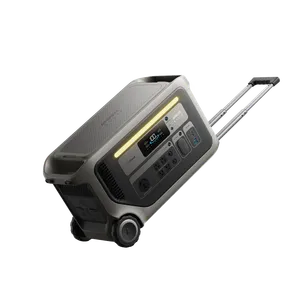
SOLIX F3000 specs
| Brand | Anker |
|---|---|
| Released | 2025 |
| Capacity | 3,072Wh |
| Continuous output | 3,600W |
| Surge output | 7,200W |
| Battery | LiFePO4, 4,000 cycles to 80% |
| Max solar input | 2,400W |
| AC recharge | ~1.5 h (solar, ideal sun) |
| Weight | 55.1 lb |
| Expandable to | 24,000Wh |
| Price tier | $$ Mid-range ($700–$1,500). See Amazon for today's price. |
- Newer model; long-term reliability data is thinner than for the F3800.
Specs and street prices compiled October 2026 from manufacturer pages and dated retailer listings — prices move weekly, so confirm on the retailer page before buying.
The Anker SOLIX F3000 is what the mid-range should look like in 2026: 3072Wh, 3600W of output, and 2400W of solar input — the fastest solar recharge in the 3kWh class — in a 55 lb box that undercuts older flagships on price.
Check current price: Anker SOLIX F3000.
Who the F3000 is for (and who should skip it)
Buy it if 2kWh isn’t quite enough but 4kWh flagships are overkill. The 3kWh capacity hits the sweet spot for a full day-plus of real household loads, and the 2400W solar input means a big array actually pays off. RV owners get a native TT-30 port — the station plugs straight into the RV’s shore-power inlet.
Skip it if you need 240V — that’s the F3800. Note it’s a newer platform, so long-term reliability data is thinner than the F3800’s. And skip it if you want the cheapest 3kWh; sale-priced F3800s sometimes undercut it.
Solar: the standout spec
2400W of MPPT is flagship-grade solar on a mid-range box. With a 2000W+ array in good sun, you’re refilling most of the 3kWh in a single afternoon — the use case that makes rolling multi-day outages survivable without a generator. The dual-MPPT design splits 1600W on the high-voltage port and 800W on the low-voltage port, so you can mix rigid roof panels with portable ones.
Real-world runtime examples
Usable capacity is ~85% of 3072Wh, about 2611Wh:
- Full-size fridge (~150W avg): ~17 hours — overnight plus a workday.
- Window AC (~1000W): ~2.6 hours of cooling.
- CPAP machine (~60W): ~43 hours — nearly a week of nights.
- RV air conditioner (~1500W): ~1.7 hours — enough to knock the heat out of the rig at bedtime, via the TT-30 port.
Capacity and output
3072Wh runs a modern fridge (~1.2kWh/day) plus freezer, lights, modem and devices for 36+ hours. 3600W continuous handles microwaves, kettles, sump pumps and job-site tools; surge covers motor startups.
How it compares
Versus the DELTA Pro 3: Anker gives you 75% of the capacity with 92% of the solar speed for much less money and 60 fewer pounds. Versus the Jackery 2000 Plus: Anker wins on capacity, output and solar; Jackery is quieter and has the deeper expansion ceiling. For RV sizing specifically, our RV power sizing guide and the RV sizer tool walk through air-conditioner math.
Home integration options
The F3000 works with Anker’s Bi-Directional Inlet Box and a transfer switch to feed home circuits during outages — up to 1800W through the home panel in that mode, with self-consumption and time-of-use modes for daily solar use. For simpler setups, the TT-30 port feeds an RV or a manual transfer switch directly at the full 3600W. Either way, plan the wiring before the storm, not during it.
Noise and placement
At 55 lb with no wheels, the F3000 is a two-hand carry to wherever it lives — garage shelf, RV bay, or closet. Fans ramp under heavy load but stay reasonable at the 1000–2000W loads that dominate real use. It’s not the ~30 dB whisper of the Jackery 2000 Plus, but it won’t dominate a room either.
F3000 vs F3800: the actual decision
It comes down to one question: do you have 240V loads? Well pump, electric dryer, 240V shop tools — yes means the F3800. Everything else, the F3000 wins: lighter (55 vs 132 lb), cheaper, same 2400W solar input, and nearly as much expansion per unit (12.3kWh vs 26.9kWh). Most buyers don’t have 240V loads and are buying inverter they can’t use. Be honest about your panel before paying for split-phase.
Bottom line
The F3000 is the sweet spot most buyers actually need: 3kWh, 3600W, and the fastest solar in its class, without flagship weight or flagship pricing. Unless you have 240V loads, start your search here.
Featured in our guides
- Home Backup Scenarios: Which Power Station for Which Outage? (2026)
- What Size Power Station to Run a Refrigerator? Runtime Math That Actually Works (2026)