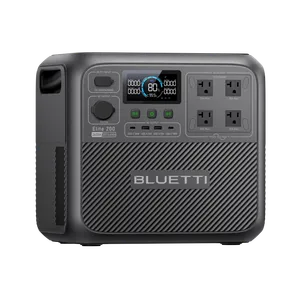
Elite 200 V2 specs
| Brand | BLUETTI |
|---|---|
| Released | 2024 |
| Capacity | 2,073Wh |
| Continuous output | 2,600W |
| Surge output | 3,900W |
| Battery | LiFePO4, 6,000 cycles to 80% |
| Max solar input | 1,000W |
| AC recharge | 0–80% in ~50 min (AC) |
| Weight | 53.4 lb |
| Price tier | $$ Mid-range ($700–$1,500). See Amazon for today's price. |
- 6000-cycle rating is the highest cycle life in our database.
- Not expandable — what you buy is what you get.
Specs and street prices compiled October 2026 from manufacturer pages and dated retailer listings — prices move weekly, so confirm on the retailer page before buying.
The BLUETTI Elite 200 V2 plays a different game from its rivals: instead of expansion or peak output, it offers the longest-rated battery life in this guide — 6000 cycles — in a compact 53 lb box with 2600W of output.
Check current price: BLUETTI Elite 200 V2.
Who the Elite 200 V2 is for (and who should skip it)
Buy it if you’ll cycle the battery hard: off-grid cabins, daily vanlife use, or time-of-use energy arbitrage where the station charges and discharges every day. Cycle life is where cheap stations die young, and this one is built for the marathon.
Skip it if you want to expand later — there is no expansion path, full stop. Skip it if fast solar recharge is the priority; 1000W of solar input is mid-pack. And skip it if you want a 2kWh box you can carry everywhere — 53 lb is light for its class but still a lift.
The 6000-cycle battery
Most LiFePO4 stations here are rated for 3000–4000 cycles to 80%. BLUETTI rates the Elite 200 V2’s cells at 6000+. For a daily-cycled station, that’s the difference between ~8 years and ~16 years of service — the single most important spec for heavy users, and the reason this unit exists.
Real-world runtime examples
Usable capacity is ~85% of 2073Wh, about 1762Wh:
- Full-size fridge (~150W avg): ~11.7 hours — a full workday of cold food.
- Starlink + router (~75W): ~23 hours — nearly a full day of off-grid connectivity.
- Portable induction cooktop (~1800W): ~1 hour of cooking — plenty for a meal.
- Home office (~150W): ~11.7 hours — two workdays of laptop, monitor and router.
Output and recharge
2600W continuous with 3900W “Power Lifting” for stubborn resistive loads covers microwaves, kettles and job-site tools. AC recharge hits 0–80% in about 50 minutes at 1800W input. The 1000W solar cap (12–60V, 20A max) means a big array is wasted — 600–800W of panels is the sweet spot (check our solar pairing calculator).
How it compares
Versus the BLUETTI AC200L: the Elite wins on cycle life, weight and recharge speed; the AC200L wins on expandability (8.2kWh) and solar input (1200W). Versus the EcoFlow DELTA 2 Max: similar capacity and output, but the Elite’s battery should outlast it 2:1 under daily cycling. For sizing your loads, see what size power station.
Why cycle life matters (and when it doesn’t)
A station cycled to 80% daily hits 3000 cycles in ~8 years and 6000 cycles in ~16. But most outage-only owners cycle 20–50 times a year — at that rate, even 3000 cycles outlasts the calendar life of the electronics. The Elite 200 V2’s 6000-cycle rating pays off only if you actually use it daily: off-grid cabins, vanlife, or time-of-use arbitrage where it charges off-peak and discharges at peak rates every single day.
Noise and standby
The Elite 200 V2 idles quietly — fans stay off under light loads and ramp with heavy sustained output. For bedroom-adjacent home offices on UPS duty, that’s meaningful. Standby drain is modest but real: leave it unplugged for months and the battery self-discharges like any lithium pack. For UPS use, keep it on grid power so the battery stays floated at 100%.
Time-of-use arbitrage: the math
Where utilities charge $0.35/kWh peak and $0.12/kWh off-peak, cycling 2kWh daily through the Elite 200 V2 saves about $0.46/day — roughly $168/year. The 6000-cycle rating is what makes this viable: a 3000-cycle station doing the same job hits 80% capacity in ~8 years, while this one is still going at 16. It’s not a get-rich scheme, but for solar owners already on time-of-use rates, the battery pays for part of itself doing daily work.