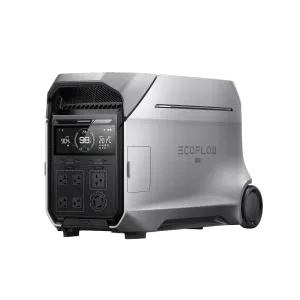
DELTA Pro 3 specs
| Brand | EcoFlow |
|---|---|
| Released | 2024 |
| Capacity | 4,096Wh |
| Continuous output | 4,000W |
| Surge output | 8,000W |
| Battery | LiFePO4, 4,000 cycles to 80% |
| Max solar input | 2,600W |
| AC recharge | 0–80% in ~50 min (X-Stream AC) |
| Weight | 113.5 lb |
| Expandable to | 12,000Wh |
| UPS switchover | 10ms |
| Price tier | $$$$ Premium ($2,800+). See Amazon for today's price. |
- X-Boost supports resistive loads up to 6000W.
- 51.5 kg — rolls on wheels, but this is not a carry unit.
Specs and street prices compiled October 2026 from manufacturer pages and dated retailer listings — prices move weekly, so confirm on the retailer page before buying.
The EcoFlow DELTA Pro 3 is the flagship argument that batteries can replace a gas generator for home backup: 4096Wh of LiFePO4 storage, 4000W of continuous pure-sine output, and 2600W of solar input that can genuinely refill it during a single sunny day. It’s the most capable single unit we track, and the heaviest and most expensive to match.
Check current price: EcoFlow DELTA Pro 3.
Who the DELTA Pro 3 is for (and who should skip it)
Buy it if your scenario is multi-day grid outages and you want to keep a fridge, freezer, lights, internet and a few high-draw appliances running without fuel runs. The 10ms UPS switchover also makes it a true uninterruptible supply for a home office — wire your desk through it and brownouts become non-events.
Skip it if you need something portable — at 113 lb it’s a roll-into-place appliance, not a carry unit. Skip it if your loads are modest: a 2kWh station like the DELTA 2 Max or Anker C2000 Gen 2 covers a fridge plus devices for half the money. And skip it if you have 240V loads — the Pro 3 is 120V-only from one unit, where the Anker SOLIX F3800 does split-phase 120V/240V natively.
Capacity and output
4096Wh is roughly two days of essentials for a frugal household (fridge ~1.2kWh/day, modem/router/lights/phones ~0.5kWh/day). The 4000W inverter is the real story: it starts and runs anything short of central AC and electric dryers, and X-Boost stretches resistive loads (heaters, kettles) to 6000W. Surge rating is 8000W for motor startups like well pumps and power tools.
Real-world runtime examples
Using ~85% of rated capacity (the inverter and BMS take their cut):
- Full-size fridge (~150W avg): ~23 hours — a full day of cold food per charge.
- CPAP machine (~60W): ~58 hours — nearly a week of nights.
- Microwave (~1000W): ~3.5 hours of actual cooking time, spread across days.
- Home office (laptop + monitor + router, ~120W): ~29 hours of work.
Add one Smart Extra Battery (another 4096Wh) and every number above roughly doubles — at which point you’re in genuine multi-day autonomy.
Charging: the fastest solar in its class
Three inputs matter. AC wall charging hits 0–80% in about 50 minutes via X-Stream — the fastest wall recharge of any flagship here. Solar takes up to 2600W across high- and low-voltage MPPT ports, which is why this unit pairs so well with big rigid panel arrays (see our solar pairing guide). It also accepts generator and alternator charging for storm scenarios.
In practice: a 1200W array (three 400W panels) in good sun pushes ~1000W real-world, refilling the battery in about 4 peak sun hours. A full 2600W array gets it done in under 2. The dual-MPPT design (separate high- and low-voltage ports) means you can mix panel types without the usual voltage-matching headaches.
Expandability and ecosystem
Two Smart Extra Batteries take the system to ~12kWh, enough for genuine multi-day autonomy with solar top-ups. EcoFlow’s app is the best in the business for scheduling, time-of-use arbitrage and storm alerts. The 5-year warranty matches the class leaders.
How it compares
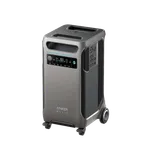
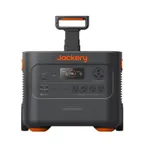
The Anker SOLIX F3800 counters with 6000W of split-phase 120V/240V output — the pick if you have 240V loads — and deeper sale discounts. The Jackery Explorer 2000 Plus is quieter and more modular but slower on solar. If 4kWh is overkill, the Anker SOLIX F3000 gives you 3kWh with the same fast solar DNA for much less. For outage planning, our home backup scenarios guide sizes all three.
Solar array sizing in practice
The 2600W solar cap is the highest here, but real arrays rarely hit nameplate. Two 400W rigid panels in series (~$500 street) typically deliver 600–700W in good sun — enough to refill the 4096Wh battery in about 5 peak sun hours. Four such panels (~1300W real) cut that to ~2.5 hours. The high-voltage MPPT port accepts long series strings, so a permanent roof or ground-mount array plugs in without special wiring. Diminishing returns set in past ~2000W of panels: the last 600W of input mostly shaves minutes, not hours. Our solar pairing guide has the voltage math.
Featured in our guides
- Portable Power Station vs Gas Generator: Which Wins for Home Backup? (2026)
- Solar Panel Pairing Guide: Which Panels for Which Power Station? (2026)
- EcoFlow DELTA Pro 3 vs Anker SOLIX F3800: Which Flagship Wins? (2026)
- Home Backup Scenarios: Which Power Station for Which Outage? (2026)